
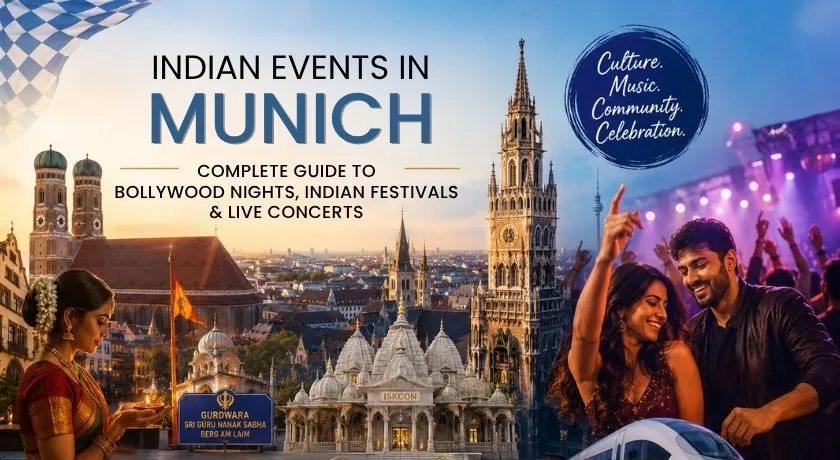
Munich doesn’t get talked about as an “Indian events city” the way Frankfurt or Berlin do. That’s a little unfair. Bavaria’s capital has one of the largest Indian communities in Germany, and its calendar is busier than most newcomers expect, with Bollywood parties most weekends, temple festivals that pull in hundreds of families, small classical dance recitals, and a student network running mostly on WhatsApp groups.
This guide is for the people actually living that calendar: Indian professionals in Munich’s tech and engineering firms, students at TUM and LMU, long-settled families in Berg am Laim and Moosach, and Germans who’ve fallen for Bollywood or Sufi music and want to know where it’s actually happening.
Munich’s Indian Community, in Brief
Munich’s Indian population has grown mainly on the back of jobs: dozens of Indian companies have offices in and around the city, concentrated in IT services, engineering, automotive and life sciences, alongside daily direct flights from Munich Airport to Delhi and Mumbai. Students are the other big driver: Indian nationals are now the largest international student group in Germany, and Technical University Munich (TUM), with its own dedicated Mumbai office, is one of the biggest draws.
That mix has produced a genuinely varied cultural scene. The community includes large Tamil, Bengali, Telugu, Punjabi, Malayali and Gujarati groups, each with its own associations and festival traditions, which is why Munich’s events calendar feels less like one big community night and more like several calendars running in parallel.
Bollywood Nights in Munich
Munich has a fairly steady rhythm of Bollywood parties. It’s not on Berlin’s nightlife scale, but consistent enough that there’s usually something within a couple of weeks.
Venues rotate. Recent and upcoming events have been hosted at G3 Club & Lounge, Americanos Club & Bar in Werksviertel, Swaad Restaurant in Berg am Laim, Palais Privat Club & Bar, and YOU LOFT Eventlocation. Promoters like Sounds of India Germany, Euro Desi Vibes, and the long-running Bollywoodfever collective are the names to follow.
Seasonal, not weekly. Rather than a fixed weekly slot, parties cluster around occasions (Valentine’s, Easter, a summer edition), plus periodic one-off nights that sometimes combine a Bollywood set with a later techno segment. Expect doors around 10–11pm, ID checks, and no-outside-alcohol policies as standard.
Bollywood vs Punjabi nights. Some Munich promoters run explicitly “Bollywood & Punjabi” nights with dhol players and heavier bhangra sets, while a straight “Bollywood Night” leans more on Hindi film chart hits. Worth checking the event description if you have a preference.
Because line-ups shift often, Eventbrite, DesiPass and the promoters’ own Instagram pages are more reliable than any static list.
Indian Festivals in Munich
Festival dates shift yearly with the Hindu lunar calendar, but who organises what stays fairly consistent.
- Diwali: one of the events already firmly established in Munich’s cultural calendar, organised mainly by cultural associations and temples, often combining a puja with a DJ segment.
- Holi: growing into one of Munich’s more visible cultural moments, drawing Indian residents and curious Germans alike; usually outdoor or semi-outdoor, weather permitting.
- Navratri, Garba and Durga Puja: grouped together since they fall in the same autumn window, though they represent different regional traditions (Garba/Dandiya for Gujarati communities, Durga Puja for Bengali families). Some Munich events combine both traditions into one evening.
- Republic Day and Independence Day: Republic Day gets an official Consulate reception; Independence Day is marked more informally by associations and, distinctively for Munich, by an annual cricket fixture (see below).
- Temple celebrations: Munich’s two religious anchors are the Gurdwara Sri Guru Nanak Sabha (Neumarkter Straße 70, Berg am Laim) and the ISKCON Krishna Temple (Wachenheimer Straße, Moosach). Both run their own festival calendars (Baisakhi and weekly langar at the Gurdwara, Janmashtami at ISKCON) and both welcome visitors without tickets.
Cultural Organisations to Know
A handful of groups do most of the organising work behind Munich’s non-nightlife events:
- IGCA e.V. (Indo-German Cultural Association): the most visible organiser of recurring festivals, running Holi, Diwali, and combined Durga Puja/Navratri events.
- Indien Institut München: running cultural and educational programmes for decades, with more of an academic bent than the party-oriented groups.
- Munich Indian Students’ Association (MISA): the main hub for students across Munich’s universities, focused on networking, orientation and cultural integration.
- Consulate General of India, Munich: hosts the official Republic Day reception and supports major community initiatives.
Joining IGCA e.V.’s or MISA’s mailing lists tends to get you dates before they hit general event listings.
Live Concerts: The Honest Picture
Munich doesn’t see the volume of large-scale, ticketed Indian concerts (major Bollywood playback singers, Sufi headliners, big touring names) that Frankfurt or Berlin regularly attract. That’s not a reflection on the community here, which is large and enthusiastic; it mostly comes down to venue economics and how international tours get routed through Germany. Munich does host smaller Indian music events, such as DJ-led Bollywood nights and occasional visiting classical artists tied to temple or association programming, but big-arena headline shows are rarer.
Why Munich Fans Travel to Frankfurt for Big Concerts
Frankfurt’s central location, international airport, and larger-capacity venues make it a natural touring stop for promoters routing an artist through Europe. One Frankfurt date can pull audiences from across western and southern Germany, which makes the economics work in a way a Munich-only date sometimes doesn’t.
The upside for Munich residents: Frankfurt isn’t remote. Direct high-speed ICE trains connect Munich and Frankfurt Hauptbahnhof in as little as 3 hours 16 minutes, with around 21 direct services daily. A Frankfurt evening concert is genuinely doable as a day trip or a one-night weekend: leave Saturday morning, catch the show, head back that night or return Sunday. It’s a pattern plenty of Bavaria-based Indian music fans already follow: when a major artist’s only confirmed German date is in Frankfurt, Munich residents build a weekend around it rather than waiting for an equivalent show closer to home.
Spotlight: The Soul of Sufism, Frankfurt
One concert worth flagging for Munich residents who’ve been waiting for a large-scale live Sufi show is The Soul of Sufism, featuring Lakhwinder Wadali and Jyoti Nooran, confirmed for Sunday, 23 August 2026 at the Jahrhunderthalle Frankfurt. Doors open at 2pm, with the show running 4pm–10:30pm; tickets range from €139.99 to €289.99. Worth double-checking final timings closer to the date via the official ticketing page.
Lakhwinder Wadali carries one of Punjab’s most significant Sufi lineages. His father and uncle formed the celebrated Wadali Brothers qawwali duo, and Lakhwinder has since become the first Punjabi artist to perform in the Red Fort’s courtyard and, in 2025, the first Asian artist in decades to perform at the Taj Mahal courtyard. Jyoti Nooran, alongside her sister Sultana, performs as one half of the Nooran Sisters, a devotional Sufi duo who crossed into Bollywood with “Patakha Guddi” (composed by A.R. Rahman for the film Highway) and later won Best Playback Singer (Female) at the Filmfare Awards Punjabi for “Yaar Di Gali.”
Together, the line-up pairs traditional Sufi devotional singing with two of Punjabi and Bollywood music’s most recognisable modern voices, a combination genuinely uncommon on a single German stage. If you’re based in Munich and have been waiting for a large-scale live Sufi concert rather than a club night, this is one of the stronger reasons on the 2026 calendar to plan a weekend trip to Frankfurt.
FAQs
Is there a big Diwali event in Munich every year?
Yes, organised mainly by cultural associations like IGCA e.V. and by the city’s temples, though exact dates shift with the lunar calendar.
Where do Bollywood parties in Munich usually happen?
They rotate across venues including G3 Club & Lounge, Americanos Club & Bar, Swaad Restaurant, Palais Privat, and YOU LOFT; following promoters on Eventbrite is more reliable than any fixed venue list.
Does Munich have a Sikh Gurdwara and a Hindu temple?
Yes to both: the Gurdwara Sri Guru Nanak Sabha in Berg am Laim, and the ISKCON Krishna Temple in Moosach.
Why does Munich have fewer big Indian concerts than Frankfurt?
Mostly venue capacity and touring logistics: Frankfurt’s central location and larger venues make it a natural single stop for promoters routing an artist through Germany.
How do I get from Munich to Frankfurt for a concert?
Direct ICE trains connect the two cities in as little as 3 hours 16 minutes, with around 21 daily services, a straightforward day trip or weekend.
Are Bollywood nights in Munich open to non-Indians?
Yes, a meaningful share of the crowd at these ticketed public events is German or other nationalities who simply enjoy the music.
What’s the difference between a “Bollywood Night” and a “Bollywood Punjabi Party”? Bollywood Night leans on Hindi film soundtrack hits; Bollywood Punjabi Party usually adds heavier Punjabi folk and bhangra, sometimes with a live dhol player.
Where can I find student-specific Indian events in Munich?
The Munich Indian Students’ Association (MISA) is the main hub, particularly for students connected to TUM.